Brisbane 2032's Organising Committee buys uniforms and signage, not stadiums
The Organising Committee's $2.5 billion program buys technology, catering, uniforms and research. Here's how businesses that don't build can register.
← All insights · By Helm Intelligence · 12 October 2026 · Pipeline
Helm Insights20 articles"The Olympics are for builders." That belief needs a proper answer, so this piece follows three illustrative businesses: a print and signage firm on the Sunshine Coast, an IT consultancy in Brisbane and a caterer on the Gold Coast. None of them is a real company, and the signage business at the centre of the piece is a composite.
Our composite owner runs a print and signage firm with, say, a dozen staff. When Brisbane 2032 comes up, she pictures cranes and assumes the work belongs to tier one contractors. The IT consultant assumes a multinational will take every technology contract. The caterer decides her business is too small to matter. None of them has registered on the supplier portal, so none of them has read the list of what's actually being bought.
That list includes signage, technology and catering. It also includes uniforms, market research and event production. And the buyer behind it doesn't build stadiums.
Venues and the Organising Committee buy separately
Venue construction and the Organising Committee's own buying are separate streams. Mixing them up is the first reason good suppliers stay away.
The Games Independent Infrastructure and Coordination Authority (GIICA) delivers the new and upgraded venues. Sunshine Coast Council's Level Up business page says the Brisbane 2032 procurement portal allows businesses to discover all work packages currently open for Expressions of Interest (EOI). Pinsent Masons treats the two as separate streams.
The Brisbane 2032 Organising Committee is a separate buyer. On 8 October 2025, the Queensland Government's Ministerial Media Statements published a statement in which its President, Andrew Liveris, said more than $2.5 billion across hundreds of procurement contracts would come from the Committee in waves over the coming years. Pinsent Masons reports a figure of A$2.5 billion, and Procurement & Supply Australasia reports a procurement strategy worth up to $2.5 billion.
That $2.5 billion isn't the Games budget, and it isn't a venue budget. It's the Organising Committee's own buying program. Most of what it buys isn't concrete.
What the Organising Committee is buying

Three public sources describe the categories, and they line up.
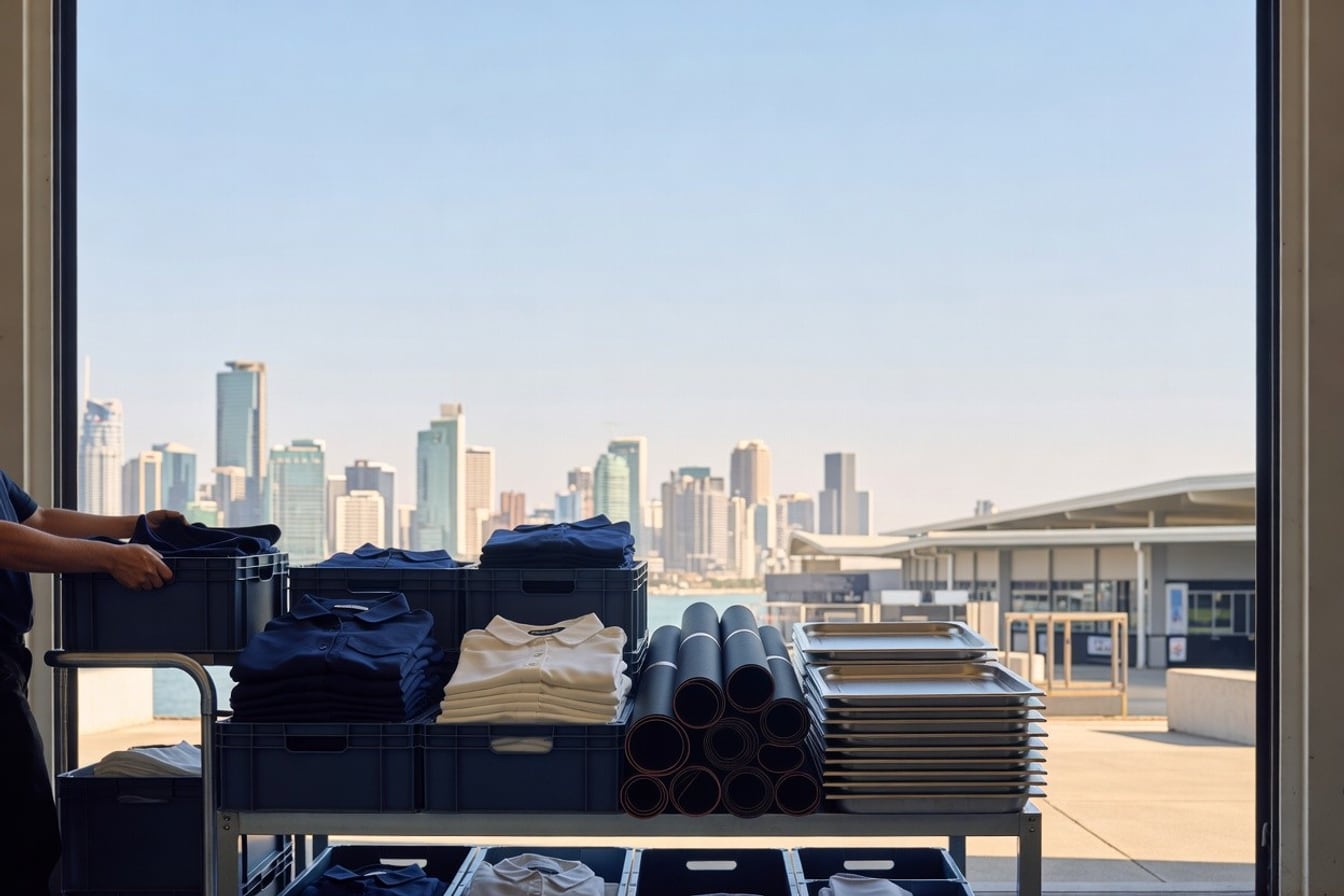
The October 2025 ministerial statement named technology, temporary venues, market research, signage and event production as early procurement categories. Pinsent Masons described the first round of packages as mostly venues, technology and branding.
The Queensland Government's statement about the Gold Coast Meet the Buyer breakfast in March 2026 went further. It said the Brisbane 2032 procurement program will source:
- temporary infrastructure
- transport
- fencing and barriers
- catering and housekeeping
- uniforms
- signage and merchandise
The Brisbane 2032 project page on ICN Gateway lists the Organising Committee as project owner. It groups the work under headings including Technology, Venues and Infrastructure, Accommodation, Security, Sport, Business Development, Procurement, People Management, and Brand, Identity and Look.
Read those headings as a business owner, not as a sports fan. A uniform manufacturer, a market research firm, a cyber security consultancy, a cleaning contractor with housekeeping crews, a hire company with fencing and barriers, a creative agency and a bus operator can all find their work in that list or in the ministerial statements.
Once our signage owner sees "signage" in a government statement, her question changes. It's no longer whether the Games are for her. It's which part of the signage work her business can deliver.
Who the program wants to buy from
The ICN Gateway project page lists local industry participation and social procurement among the project's priorities. Procurement & Supply Australasia reports that Aboriginal and Torres Strait Islander-owned, women-owned, disability-owned and regional businesses are priority suppliers.
The Queensland Government has also taken the buyers on the road. Its Ministerial Media Statements described a Gold Coast Meet the Buyer breakfast in March 2026.
That's the answer for the caterer who thinks she's too small. A priority on local participation and social procurement tells you who the buyer wants to hear from. It means a ten-person Queensland business is the kind of supplier the program says it's looking for.
How to register, and why partial scope matters

The first step costs nothing. The Brisbane 2032 supplier portal, Gateway by ICN, is built for exactly this job. Registration is free.
Three steps are worth taking when you register.
- Complete the company profile. The project page warns that incomplete company profiles may not be considered. Fill in every field you can back with evidence.
- Use the partial scope path. You can submit an expression of interest for the full scope of a package or for part of it, and Sunshine Coast Council's Level Up page confirms that partial capability bids can still be considered. Our signage firm doesn't need to supply every sign for the Games. She can register for the part she does best, say signage for one precinct. ICN shares those details with the businesses that win the head contract, and this path is the smartest thing on the portal.
- Write the profile for head contractors as well as the Committee. Whether a head contractor calls is up to them, which is exactly why the profile needs to be good.
Partial scope is what turns "we're too small" into a real option. The IT consultant who can't run a Games-wide technology platform may well deliver a defined piece of one. The caterer who can't feed every venue may cover a slice of the catering and housekeeping work. Neither has to pretend to be bigger than they are.
Keeping track once you're registered
Registering puts you on the list. It won't tell you when the rest of your market moves, and the Organising Committee is one buyer among many. A business that watches only one portal finds the rest late. A tender you find with eight days left usually means a rushed response or no response, and either way the hours you put in are hard to get back.
Helm Tender brings Queensland Government, Brisbane City Council and federal tenders into one feed. It scores each one from 0 to 100 against what your business actually does, with every add and subtract labelled, and quotes forward procurement signals from the agencies' own published plans. If a Brisbane 2032 package reaches you that Helm Tender doesn't index, paste it in and it becomes a full workspace with the same scoring and reminders 7, 3 and 1 days before close. You can track all of this by hand or have Helm Tender do it for you, and you still review, own and submit every response yourself.
See which tenders fit your business at https://helmtender.com.au/?utm_source=web&utm_medium=insights&utm_campaign=helm-tender
Questions this raises
Sources
- Queensland Government Ministerial Media Statements, 8 October 2025
- Queensland Government Ministerial Media Statements, Gold Coast Meet the Buyer, March 2026
- ICN Gateway: Brisbane 2032 project page
- Sunshine Coast Council Level Up: Brisbane 2032 procurement
- Procurement & Supply Australasia: Brisbane 2032's $2.5 billion procurement strategy unveiled
- Pinsent Masons Out-Law: Brisbane Olympics procurement portal
Join the conversation on LinkedIn →
#Brisbane 2032#Portals and registration#Small business#Subcontracting and supply chain